The Executive Spotlight Problem: Why Centering Every Event on Senior Leadership Quietly Undermines the Culture You're Trying to Build
The Stage Has a Cost You're Not Accounting For
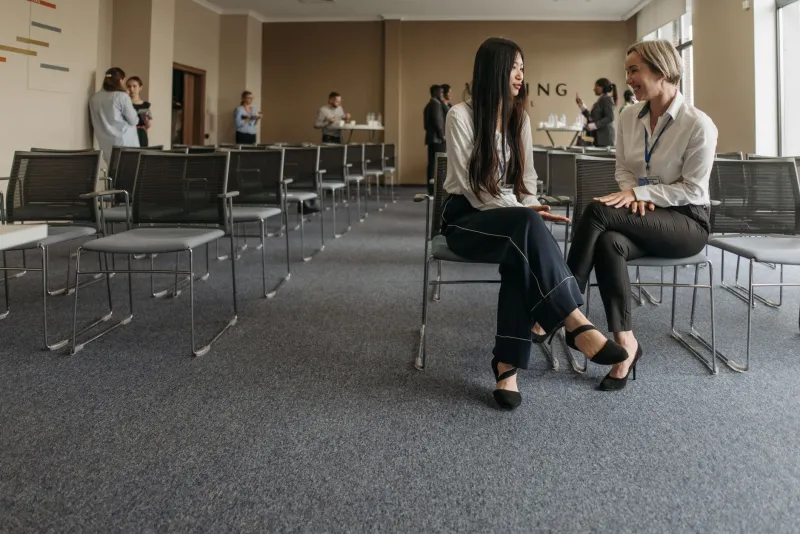
There is a particular image that repeats itself across corporate America: the CEO at the podium, the room arranged in rows, hundreds of employees oriented toward a single figure who carries the weight of the message, the mood, and the moment. It feels authoritative. It looks organized. And in many cases, it quietly works against everything the event was designed to accomplish.
This is the executive spotlight problem — and it is far more common, and far more consequential, than most organizations recognize when they begin planning a major internal gathering.
At Universal Special Events, we work with organizations across a wide range of industries, and one of the most consistent patterns we observe is the assumption that leadership presence automatically produces leadership impact. It does not. Presence and impact are related, but they are not the same thing, and the difference between them is largely a function of how an event is designed.
What Over-Reliance on Executive Presence Actually Signals
When senior executives appear at every significant moment of a corporate event — opening remarks, closing statements, panel discussions, award presentations — the organizational message being transmitted, whether intentional or not, is that authority flows from a single point. Employees absorb this signal quickly. The gathering becomes something that is happening to them rather than something they are genuinely part of.
This matters because the purpose of most internal corporate events is not simply to inform employees. It is to build alignment, reinforce culture, recognize contributions, and generate momentum. None of those outcomes are reliably produced by an audience watching a stage. They emerge from experiences in which employees see themselves and their peers reflected in the structure of the event itself.
When a company's entire event architecture consistently positions the C-suite as the source of all meaning and momentum, it creates a subtle but measurable disengagement. Employees may applaud on cue, but they leave without the sense of personal investment that transforms a well-run gathering into a genuine cultural inflection point.
The Paradox of Executive Diminishment
Here is the counterintuitive truth that experienced event professionals understand well: senior leaders often carry more weight in a room when they appear strategically rather than constantly.
Consider the difference between a CEO who opens every session, moderates every panel, and closes every segment — and a CEO who delivers a focused, well-placed address at a pivotal moment, then steps back while other voices carry the program forward. In the second scenario, the executive's presence is amplified precisely because it is not ubiquitous. The message lands with greater force. The contrast between the leader's voice and the broader organizational chorus makes both more meaningful.
This is not a peripheral observation about optics. It reflects a foundational principle of event architecture: scarcity creates significance. When the same voice fills every hour of a gathering, even the most compelling speaker becomes ambient noise. When that voice is reserved for moments of genuine strategic weight, it commands the room in a way that repetition never can.
Distributing Authority Without Diluting It
The practical question, of course, is how an organization moves away from executive-centric event design without creating a vacuum of leadership or sending the wrong signal about organizational direction.
The answer lies in what we call distributed authority design — a deliberate approach to event structure that identifies multiple voices, roles, and moments of visibility across different levels of the organization, and builds the program around that broader map of leadership.
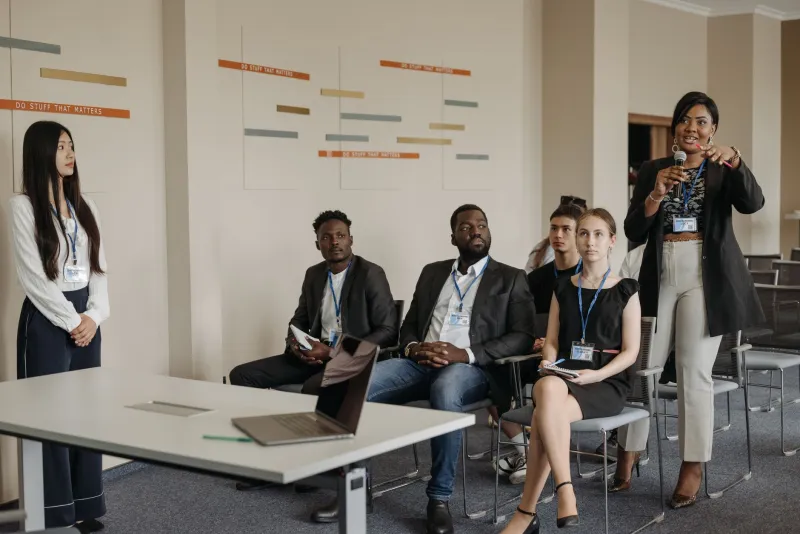
This might mean positioning high-performing mid-level managers as session facilitators rather than passive attendees. It might mean structuring breakout conversations so that department heads lead substantive discussions in their areas of expertise, rather than simply relaying messages handed down from above. It might mean designing recognition segments that are facilitated by peers rather than executives, so that the act of acknowledgment carries the texture of genuine relationship rather than institutional ceremony.
None of this happens by accident, and none of it is as simple as removing the CEO from the agenda. It requires careful pre-event work: understanding the organization's culture, identifying the individuals whose credibility spans teams, designing facilitation frameworks that give non-executive voices the structural support they need to hold a room effectively. The planning investment is real. So is the return.
What Employees Actually Remember
Research on organizational memory is consistent on this point: people recall experiences in which they were active participants far more vividly than experiences in which they were observers. The corporate event that employees describe months later is rarely the one with the most polished keynote. It is the one in which they felt recognized, heard, and genuinely connected to colleagues they rarely encounter in the ordinary flow of work.
That kind of memory is not created by executive presence. It is created by event design that deliberately manufactures the conditions for authentic connection — across hierarchical lines, across departments, across the ordinary boundaries that structure daily organizational life.
When a senior leader is present for those moments of connection rather than presiding over them, the effect on organizational culture is qualitatively different. The leader is not the source of the experience. The leader is a participant in it, which is a far more powerful cultural signal than any prepared remarks can deliver.
The Planning Conversation Most Organizations Skip
For most internal corporate events, the planning conversation begins with logistics: venue, catering, audio-visual, agenda timing. The question of who should speak, when, and why is often treated as a matter of protocol rather than strategy — executives speak because they are executives, not because their presence at a specific moment serves a defined purpose.
A more productive starting point is to ask what the event is actually trying to accomplish at a cultural level, and then work backward to determine which voices, at which moments, best serve that goal. Sometimes the answer is the CEO. Often, the answer is someone else — or several someone elses — whose visibility in that moment would send a more precise and more powerful message to the organization.
This is the kind of strategic conversation that transforms a competently executed gathering into an event with genuine organizational consequence. It requires honesty about the gap between hierarchical habit and actual impact — and a willingness to design around that gap rather than reinforce it.
Rethinking the Role of the Room
The most effective corporate events are not performances. They are environments — carefully designed spaces in which specific kinds of interaction, recognition, and shared experience become possible. When every element of that environment is oriented toward a single figure on a stage, the environment is working against its own purpose.
Distributing leadership presence across an event is not a diminishment of executive authority. It is a maturation of it — a recognition that the most durable cultural influence a senior leader can have is not the one projected from a podium, but the one embedded in an organizational culture that has genuinely internalized the values and direction that leadership is trying to advance.
Designing events that serve that goal is both an art and a discipline. It begins with a clear-eyed assessment of what the room needs to accomplish — and the honesty to recognize that the answer is not always another keynote.